
new normal is same old shit
HD video, 5:49 minenglish intertitles
I MET A NUDE FIGURE FROM DUCHAMP'S ÉTANT DONNÉS ON SEX CAMS
The work addresses the contemporary representation of the human body on webcams.
Bodies seeking experience in intimate participation through live streaming formally echo Courbet's L'Origine du mondeand Duchamp's Étant donnés. In the work's text, the desire for closeness breaks down into a repeated, fragmented call: "Me / Be me / Be with me / Be with / Me", as if identity could only hold together in the act of addressing someone else.
Although entirely realized as a 3D animation, the work adopts the language of silent cinema: longer passages from Jolanta Brach-Czaina's Szczeliny istnienia [Cracks in Existence] (1992) appear as intertitles, while the rest of the text (an interior monologue) is layered directly over the animation. A single body exceeds the boundaries of the individual to whom it belongs: the work describes it as "the body of the world", in which individual experience merges with something universal.
The work asks to what extent we can actually control the way our own body becomes an image. Live streaming appears to give that control to the person in front of the camera, allowing them to decide what to show, from what angle, and to whom, creating a sense of power over one's own representation. At the same time, the frame remains an echo of earlier images, repeating conventions of representation that once shaped the classical nude. An everyday activity, seemingly unrelated to art, thus turns out to belong to a much older way of looking.


produced with support of Adam Mickiewicz Institute
(PL)
Praca dotyczy współczesnej reprezentacji ciała ludzkiego na kamerach internetowych.
Ciała poszukujące doświadczenia intymnego uczestnictwa poprzez transmisję na żywo formalnie przywołują L'Origine du monde Courbeta i Étant donnés Duchampa. W tekście pracy pragnienie bliskości rozbija się na powtarzane, urywane wołanie: „Me / Be me / Be with me / Be with / Me”, jakby tożsamość mogła się utrzymać tylko w akcie zwrócenia się do kogoś drugiego.
Choć całość zrealizowana jest jako animacja 3D, praca przyjmuje język kina niemego: dłuższe fragmenty z książki Jolanty Brach-Czainy Szczeliny istnienia (1992) pojawiają się jako plansze z tekstem (intertitles), podczas gdy reszta tekstu (monolog wewnętrzny) nakłada się bezpośrednio na animację. Pojedyncze ciało przekracza granice tego, do kogo należy: praca opisuje je jako „ciało świata”, w którym jednostkowe doświadczenie stapia się z czymś uniwersalnym.
Praca pyta, na ile rzeczywiście można kontrolować sposób, w jaki własne ciało staje się obrazem. Livestreaming pozornie oddaje tę kontrolę osobie przed kamerą - pozwala zdecydować, co pokazać, pod jakim kątem i komu, dając poczucie władzy nad własnym wizerunkiem. Jednocześnie kadr pozostaje echem wcześniejszych obrazów i powtarza konwencje przedstawiania, które kształtowały klasyczny akt. Codzienna czynność, pozornie niemająca nic wspólnego ze sztuką, okazuje się więc należeć do znacznie starszego sposobu patrzenia.
“THE INVISIBLE MAY BE HIDDEN IN GAPS, CRACKS THAT LEAD WITHIN, UNDERNEATH THE SURFACE, TO THE OTHER SIDE OF REALITY. THE SAME REALITY, THOUGH.”
What is given?
Just you and me.
Or just me?
I
I can hear you breathing.
So you are more than anonymous eyes.
“BY LOOKING WE NOT ONLY EXTRACT THE OBSERVED REALITY, BUT ALSO WAKE IT UP. IT COULD SEEM THAT SIGHT IS MERELY A TOOL OF OBSERVATION, BUT IN FACT IT ALSO CREATES.”
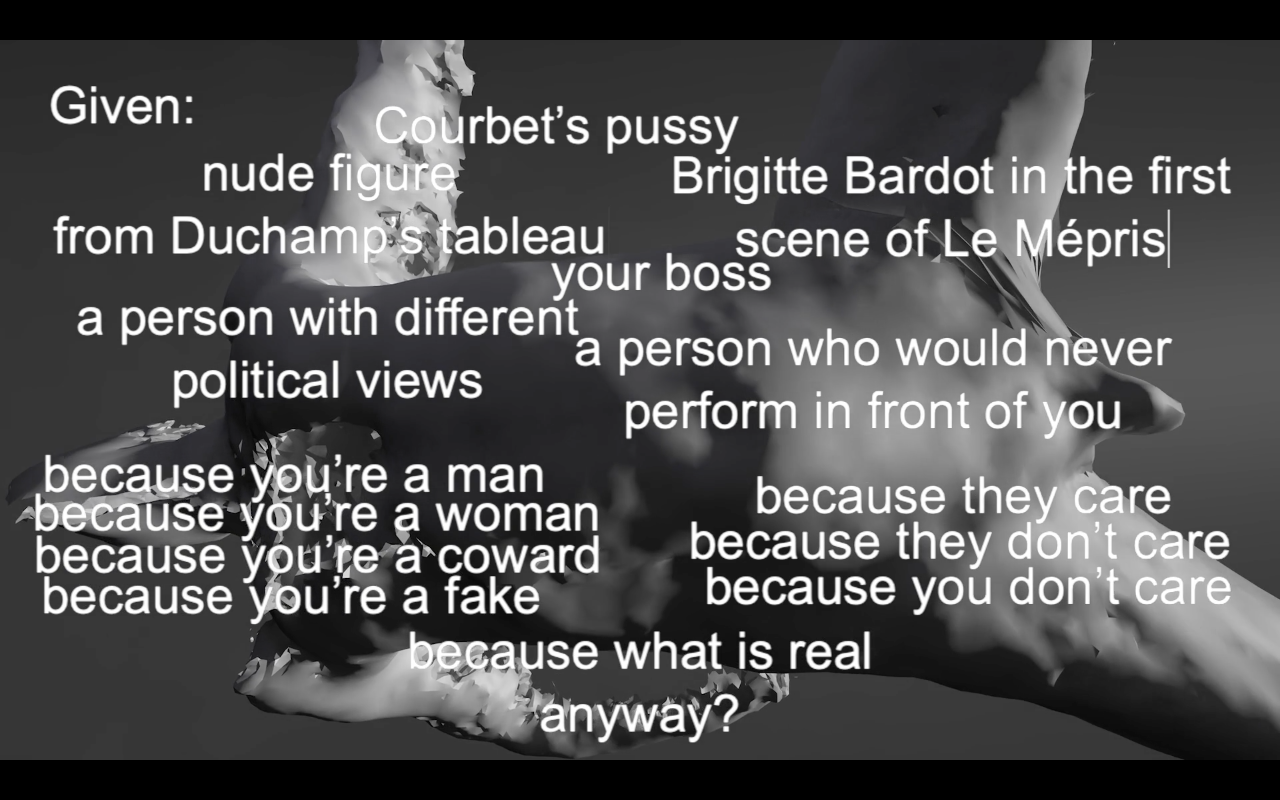
Given: Courbet’s pussy, nude figure from Duchamp’s tableau, Brigitte Bardot in the first scene of Le Mépris, your boss, a person with different political views, a person who would never perform in front of you because you’re a man, because you’re a woman, because they care, because they don’t care, because you don’t care, because you’re a coward, because you’re a fake, because what is real anyway? I also don’t have to be anyone in particular.
“I CAN SEE NOW THAT THE DISCUSSED PROBLEM REVERSES THE PERSPECTIVE OF PLATO’S CAVE BECAUSE – CONTRARY TO WHAT PLATO BELIEVED – WE USUALLY OPERATE IN THE INTENSE SUNLIGHT OF BRIGHTNESS, AMONG KNOWN AND FIRM VALUES, WHILE LACKING WHAT REMAINS IN THE CRACK, ALTHOUGH THERE IS NO TRUTH THERE AS WE ARE FACING A MYSTERY, THERE IS NO PURE GOOD SINCE IT DOES NOT EXIST WHERE IT CANNOT BE SEPARATED FROM EVIL.”
“IMMERSION, HOWEVER, POSES A CERTAIN THREAT TO INDIVIDUAL EXISTENCE. FOR IN A STATE OF COMPLETE PERMEATION, CONFUSION OF THE SIDES, MUTUAL INFILTRATION, IT IS DIFFICULT TO DETERMINE WHAT EXISTS IN WHAT, WHAT IS THE IMAGE AND WHAT IS ITS BACKGROUND.”
The frame I choose,
What I expose,
What I keep out of view,
The ways you can access the image
Give me control over my representation.
But my representation is just an echo,
But my representation is just an echo
Of Courbet’s pussy, the nude figure from Duchamp’s tableau, Brigitte Bardot in the first scene of Le Mépris, your boss, a person with different political views.
“MY BODY THUS BECOMES THE BODY OF THE WORLD.”
“ONE MIGHT SAY WE FORM SOMETHING OF A NATURAL COMPOUND OF THE INTIMATE AND THE UNIVERSAL FORM OF EXISTENCE. OUR PERSONAL EXPERIENCE NOT ONLY GOES BEYOND OURSELVES, BUT ALSO BEYOND HUMAN EXPERIENCE TOWARDS COMPLETE UNIVERSALITY, TOWARDS COMPLETE EXISTENCE, WHICH WE EMBODY AND POINT AT WITH OUR INDIVIDUAL PRESENCE.”
The Old Masters’ drives are echoed in my drives.
Me
Be me
Be with me
Be with
Me
“IT’S EASY TO NOTICE THAT EACH OF US IS A CRACK IN REALITY. NOT ONLY FOR OTHERS BUT ALSO FOR ONESELF. THE WORLD CRACKS IN THE PLACE WHERE WE ARE.”
And no matter if you call it immersion or illusion.
Contains quotations from Jolanta Brach-Czaina’s book Szczeliny istnienia [Cracks in Existence] from 1992.